REVIEW · HANOI
Vietnam Fishing village photography tours
Book on Viator →Operated by Momentlives Photography tours · Bookable on Viator
Real fishermen. Real light.
This Vietnam fishing village photography tour turns sunrise-to-sunset shooting into story-driven frames—boats coming in, seafood sorting on the sand, and candid portraits in traditional working scenes. I also love that the focus isn’t just on boats. You’ll photograph the fishing tools and even the processes of making salt, so your images feel specific, not generic.
I got the sense that the day is built around being in the right place when action happens. Hundreds of boats return to Nam Đinh beach, then the work keeps moving: wives handle the catch, nets get hauled in, and sales happen right by the water. One consideration: it’s physically active by beach standards and it requires good weather, so you’ll want to plan for a long day on uneven ground.
What makes it easier to enjoy is the small size and smooth support. The group max is 6, there’s pickup offered, and you’re covered with an air-conditioned vehicle plus accommodation. On the kind of photo trip this team runs, they’ve worked with local leads such as Hoa, which helps you feel guided—not rushed.
In This Review
- Key highlights
- Nam Đinh beach: where the morning work becomes your photo storyline
- Fishing tools, long nets, and the kind of scale most photos miss
- Salt making: using craft and texture when the light turns golden
- Afternoon boat repairs: the unscripted details you’ll want in your final set
- Sunrise-to-sunset timing: how this schedule improves your photos, not just your day
- Price and value: is $408 a fair deal for two days of photo-focused access?
- Logistics that actually affect your photos: pickup, pacing, and meals
- Who this tour suits best (and who might want a different option)
- Should you book Vietnam Fishing village photography tours with Momentlives?
- FAQ
- What time does the tour start?
- Is pickup included?
- What’s the group size limit?
- What meals are included?
- Where is the experience based?
- Is the tour suitable if I’m not very fit?
- Does weather affect the tour?
Key highlights
- Sunrise-to-sunset photo time built for portraits, low light, and storytelling
- Nam Đinh beach scenes: boats landing, seafood sorting, and sales by the shore
- Fishing nets and tools photographed as real objects, not just background scenery
- Salt-making processes that add texture and craft to your sequence
- Afternoon boat and net repairs for gritty, human-detail images
- Small group (max 6) with a full day’s pacing that won’t feel chaotic
Nam Đinh beach: where the morning work becomes your photo storyline
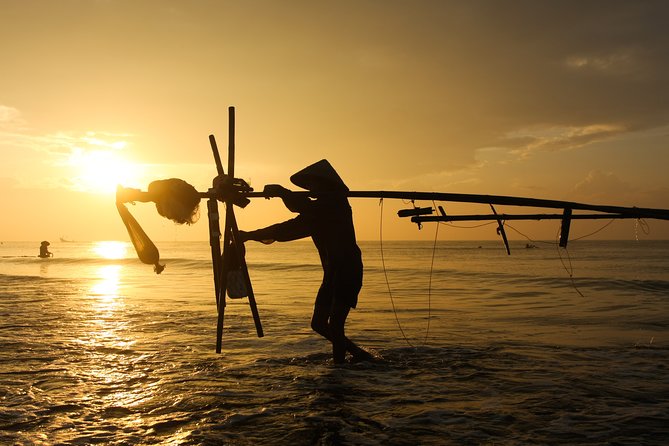
This tour’s heart is early morning on Nam Đinh beach, when hundreds of fishing boats come back after a night out. The timing matters. The light is soft, and the action is concentrated: boats hit shore, and the beach turns into a working station.
One of the most photo-friendly moments is when husbands focus on hauling boats ashore while wives take over the catch. You’ll see seafood sorting done meticulously, then selling right by the beach. That combo—activity, texture, and direct human focus—gives you frames with real context. It’s not just a “pretty” scene; it reads like a full day’s work.
As buyers arrive, the story extends beyond the shoreline. Catch gets transported to restaurants in town, which means your images can hint at the whole chain, not only the catching. If you like photos that explain the place, this structure works.
You can also read our reviews of more tours and experiences in Hanoi.



Fishing tools, long nets, and the kind of scale most photos miss
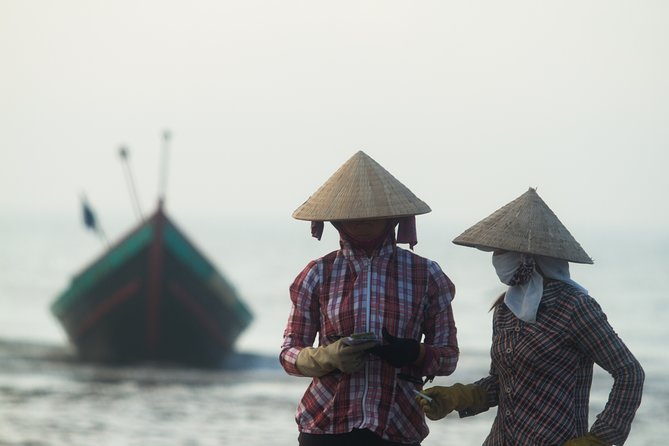
If you’ve ever photographed fishing anywhere, you know the challenge: nets and tools can be hard to show clearly. Here, the tour leans into it. You’re meant to photograph the unique fishing tools and how they’re used, so your viewer understands what they’re looking at.
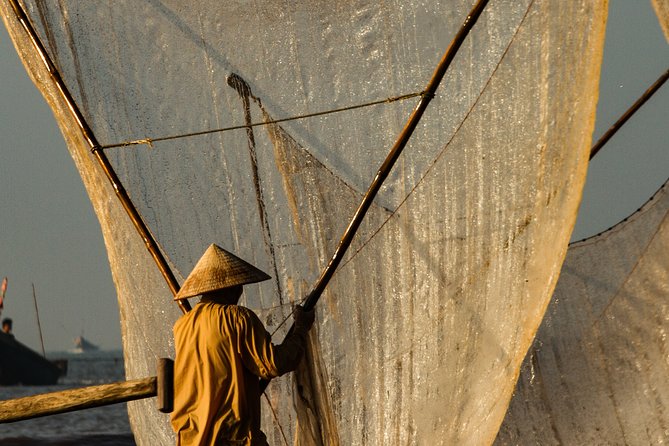
The most dramatic example is the massive net set across hundreds of meters of water. Each end gets pulled by 10 to 15 strong people, so you can capture both the geometry of the net and the effort of the crew. After a few hours, the catch comes in, then gets gathered ashore, sorted, and sold.
There’s also the shoreline fishing that happens on stilts. Men scoop into the sea bed for small fish, aiming for weight like 10 kg or so. That “small fish, steady expectation” detail can be a great counterpoint to the big net scenes. In your sequence, it adds variety without leaving the theme.
A practical note: scenes like these move fast, but they’re also repeatable. Nets get set, then pulled. Sorting happens in rhythm. That repeatability is gold for composition—especially if you want a set of images with a clear beginning, middle, and ending.
Salt making: using craft and texture when the light turns golden
The tour also includes photographing the processes of making salt. Even without a technical walkthrough in the materials, you can treat this as a photography strength: salt making creates strong visual textures, clean lines, and patterns made by work.
This also fits with the tour’s timing. You’re photographing from sunrise to sunset, which means you can chase both bright detail and softer tones. Salt work often benefits from low angles and side light, where surface texture shows. In other words, it’s the kind of subject that rewards patience.
The payoff for you is variety. Fishing is kinetic—hands, boats, nets, motion. Salt making is more methodical—processes, surfaces, materials. When you mix those two, your photo set feels complete rather than repetitive.
Afternoon boat repairs: the unscripted details you’ll want in your final set
In the afternoon, the shoreline shifts from catching to fixing. Fishermen gather to repair ill-equipped boats and torn fishing nets. This is a quieter time, but it’s not “less important” for your photos. It’s where you often find the most honest details.
Look for images that show wear: repaired sections, working hands, and the practical arrangement of tools. If your goal is story telling, repairs are the bridge between one fishing cycle and the next. They show resilience and routine.
There’s also a composition advantage. Boat and net repairs tend to create natural foreground layers: hands, rope, fabric, wood, and the beach line behind them. That layering helps you build depth without trying too hard.
If you like photos that feel lived-in rather than staged, don’t treat the afternoon as a break. Use it to photograph the “in-between life” that makes the morning scenes believable.
Sunrise-to-sunset timing: how this schedule improves your photos, not just your day
The tour’s photography time is designed to span from sunrise to sunset. That matters because cameras don’t just need light—they need the right light for the right job. Early light supports portraiture with gentle shadows and skin-friendly contrast.
As the day progresses, you get different conditions for composition. You can frame the nets and boats when the scene isn’t flat, then switch to more narrative shots during the working peaks. When light drops, low-light moments become available, especially with people-focused scenes at the beach edge.
What I like about this approach is that it’s not only about shooting early. Many photo days burn out after the morning highlight. Here, the afternoon includes real work too—so you’re not stuck waiting for perfect conditions. You’re continuously photographing because the environment provides new angles and new tasks.
If you’re bringing a camera setup, plan for a long shooting stretch. That’s one reason the group size is kept small. With max 6, it’s easier to keep an eye on where people are working and position yourself without getting elbowed into the net by someone with a tripod and big dreams.





Price and value: is $408 a fair deal for two days of photo-focused access?
At $408 per person for about two days, the price isn’t just “transport and a guide.” It includes accommodation plus air-conditioned vehicle, and it covers all meals except breakfast on Day 1 and dinner on Day 2. You also get coffee and/or tea.
Here’s how I judge the value for this kind of photo tour: access and time. Being on Nam Đinh beach during the exact flow of returning boats, sorting, net hauling, and sale-by-the-shore scenes is hard to replicate alone. You’d need local knowledge, timing, and a comfort level being in active working areas.
On top of that, the tour adds salt making and fishing tools as dedicated photo subjects. That means you’re not paying only for one location. You’re paying for a guided sequencing of themes that fit photography—from portraits to low-light storytelling.
So yes, $408 may sound specific, but the “included” list is what makes it make sense. You’re not constantly thinking about logistics while trying to shoot. You’re thinking about frames.
Logistics that actually affect your photos: pickup, pacing, and meals
The start time is 8:30 am, and pickup is offered. That reduces the chance you waste your best shooting light figuring out where to meet. You also get a mobile ticket, which tends to make check-in simpler when you’re moving quickly.
The group size max is 6. For photography, that’s a big deal. Smaller groups keep noise down and make it easier to find space to work. It also helps the guide team keep you aligned with what’s happening next on the beach.
Meals are partially included: all meals are covered except breakfast on Day 1 and dinner on Day 2. Practically, that means you should plan to eat on your own for those two spots. When a day runs from morning action into afternoon repairs, you’ll be grateful not to manage every meal.
One more practical point: the tour asks for moderate physical fitness. You’ll likely be walking on beach terrain and moving around while scenes shift. You don’t need athlete-level stamina, but comfort with a long day helps.
Who this tour suits best (and who might want a different option)
This fits best if you care about photographing work: hands, tools, net geometry, and the small details that add truth to a story. If your camera style includes portraits and low-light work, the sunrise-to-sunset rhythm is a strong match.
It also suits you if you like authentic scenes rather than staged sightseeing. The beach sells catch right by the shore, nets get hauled in with real labor, and repairs happen in the afternoon. That’s the kind of material that makes your photos feel like you were there for a reason.
If you dislike early mornings, long outdoor blocks, or active beach walking, you might find the schedule taxing. The experience also requires good weather, so if conditions are poor, plans shift.
Lastly, if you want only famous landmarks, this isn’t that kind of trip. This is about making images that explain how fishing life works.
Should you book Vietnam Fishing village photography tours with Momentlives?
I’d book it if your goal is a photo set with real narrative. The combination of Nam Đinh beach action, salt making, fishing tools, and afternoon boat repairs gives you enough variety to avoid a one-note portfolio.
I’d also book it if you don’t want to do the hard part alone. Getting the timing right—boats returning, sorting underway, nets hauled—takes local know-how. With pickup, air-conditioned transport, and accommodation handled, you can focus on the camera and the story instead of logistics.
The only reason to hesitate is weather dependence and the physical “moderate” factor. If you’re prepared for that, you’ll likely come away with images you can’t easily recreate on a solo day trip.
FAQ
What time does the tour start?
It starts at 8:30 am.
Is pickup included?
Pickup is offered.
What’s the group size limit?
The tour/activity has a maximum of 6 travelers.
What meals are included?
All meals are included except breakfast on Day 1 and dinner on Day 2.
Where is the experience based?
The tour is listed from Hanoi, Vietnam, and it focuses on fishing village scenes like Nam Dinh beach.
Is the tour suitable if I’m not very fit?
It requires moderate physical fitness.
Does weather affect the tour?
Yes. It requires good weather, and if it’s canceled due to poor weather, you’ll be offered a different date or a full refund.