REVIEW · BERLIN
Romantic Berlin Rickshaw City and Photo Tour – incl. pick-up
Book on Viator →Operated by Rikscha & Bier Bike & Party Beer Bike - Leo Rickshaw Tours · Bookable on Viator
Berlin is best seen slowly, with a camera-ready plan. This romantic rickshaw city tour turns landmark-hopping into an easy, private ride with photo stops built in. And with pickup near Brandenburg Gate plus a photographer along the way, you get both the views and the visuals without having to figure out route logistics.
I particularly like the mix of classic Berlin landmarks and the more emotional stops tied to 20th-century history. You’ll enjoy the warm blanket, WiFi on board, and music on request (yes, even on a chilly day), plus the fact that it’s private—just you and your group—so you can take photos at the pace that works.
One thing to consider: it’s a 1–2 hour experience with many photo stops, so you won’t hang around any single site for long. Also, the tour depends on decent weather, and cold conditions can feel real even with the blankets.
In This Review
- Key highlights at a glance
- Rickshaw romance in Berlin: how the photo-circuit really feels
- Pickup near Pariser Platz: getting started without stress
- The must-see stops, from Brandenburg Gate to Checkpoint Charlie
- Brandenburg Gate: the classic starting line
- Reichstag Building: politics, fire, and a dome you can’t ignore
- Soviet memorial: T-34 tanks and graves behind the bronze
- Berlin Zoo grounds: English-style park calm in the middle of the city
- Potsdamer Platz: modern Berlin district planning
- Topography of Terror: where Nazi systems were planned and controlled
- Martin-Gropius-Bau and the Wall: culture and division, side by side
- Checkpoint Charlie: the famous border crossing
- Friedrichstraße: shopping mile energy after the Wall
- Gendarmenmarkt: French settlers, then a theater landmark
- Bebelplatz book burning memorial: a chilling reminder
- Neue Wache: a central memorial for war and tyranny victims
- Museum Island and Berlin Cathedral: world-class architecture zone
- New Synagogue on Oranienburger Strasse and Nikolaiviertel: faith and old-town texture
- Alexanderplatz: big square, big Berlin energy
- The photo setup: photographer, WiFi, and that warm-ride comfort
- Price and value for a private up-to-2 group
- Cold-weather reality and what to do with it
- Who this romantic Berlin rickshaw-and-photo tour suits best
- Should you book this romantic rickshaw-and-photo tour?
- FAQ
- FAQ
- How long is the Romantic Berlin Rickshaw City and Photo Tour?
- What’s the group size for this tour?
- Is pickup included?
- Is the tour offered in English?
- What’s included in the tour price besides the rickshaw ride?
- Are entrance tickets included for the stops?
- Is the tour dependent on weather?
Key highlights at a glance
- Pickup near Brandenburg Gate keeps you from wasting time getting started
- Photo help with a photographer means you’re not stuck guessing angles
- Warm blanket + music on request makes the ride more comfortable and fun
- Cold War to modern Berlin stops give you variety in a short window
- Private transport for up to 2 makes the whole experience feel personal
- Alcoholic beverages included add a nice romantic touch if that’s your thing
Rickshaw romance in Berlin: how the photo-circuit really feels
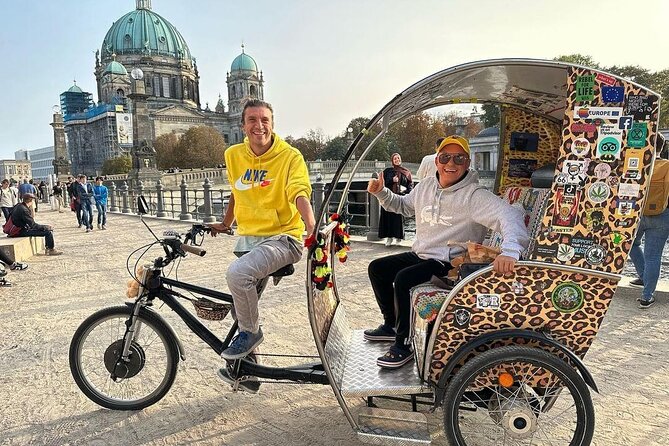
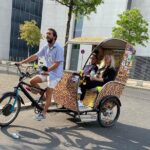
This is the kind of Berlin tour that fits a simple travel truth: the city is packed, and most people waste time. Here, the plan does the work for you. You climb into a rickshaw, you glide through central areas, and you pause at key spots that are either visually iconic or historically loaded. It’s romantic in the practical sense—quiet riding, photo-ready viewpoints, and space to talk—rather than a scripted performance.
The “photo tour” part matters. You’re not just being taken past famous places; you’re being set up for pictures. Even if you’re an occasional camera user, you’ll appreciate having someone help with composition and timing, especially around architecture and memorials where lighting and sightlines matter.
And because this is private (your group only), you’re not getting swept along by a crowd. You can stop for the photo you actually care about, ask for a slightly different angle, or spend an extra minute reading what you want to read. That flexibility is a real value boost in a city like Berlin.
You can also read our reviews of more tours and experiences in Berlin.
Pickup near Pariser Platz: getting started without stress
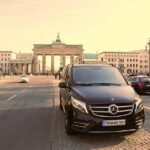
The meeting point is Pariser Platz 4A, close to Brandenburg Gate. The tour also offers pickup within a 2 km radius from Brandenburg Gate. If you’re farther out than that, you’ll be charged €10 per km, paid on the spot.
That pickup detail is bigger than it sounds. In Berlin, the good viewpoints are often a little off the easiest walking routes. Starting near the heart of Unter den Linden and Brandenburg Gate means you waste less time and you get to your first landmark fast—before crowds build and before the light changes.
The tour ends back at the meeting point, so you don’t end up wondering how to get home or where to continue. For a 1–2 hour window, that loop is worth something.
The must-see stops, from Brandenburg Gate to Checkpoint Charlie
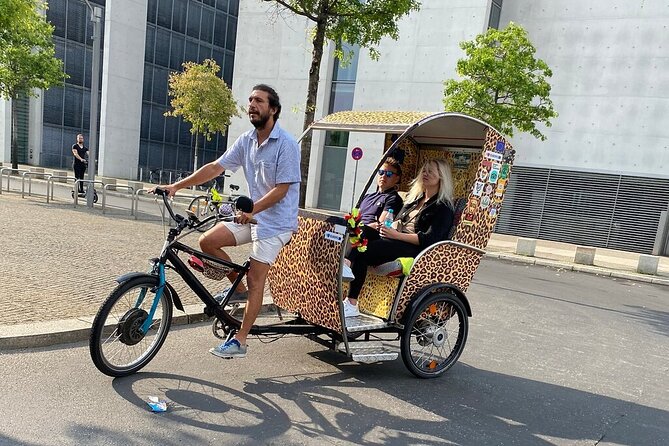
You’ll hit a strong sequence of Berlin’s eras—classicism, empire, dictatorship, division, reunification-era memory, and then modern city life. Think of it as a compressed storyline with frequent photo breaks.
Brandenburg Gate: the classic starting line
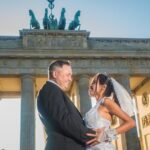
Your route begins at the Brandenburg Gate, built between 1788 and 1791 based on designs by Carl Gotthard Langhans the Elder. The gate was ordered by King Friedrich Wilhelm II to finish the boulevard Unter den Linden.
Why it works as a tour opener: it’s instantly recognizable, it frames Berlin’s “grand center” look, and it’s a clean place to get your bearings. Sandstone and symmetry photograph well from multiple angles, and a rickshaw stop here gives you a romantic sense of “we’re in the main story now.”
Tip: if it’s windy or cold, use the rickshaw as your little windbreak while you get a few steady shots.
Reichstag Building: politics, fire, and a dome you can’t ignore
Next up is the Reichstag Building. The tour context matters here. You’ll learn about the republic being proclaimed on November 9, 1918 by SPD politician Philipp Scheidemann from the balcony at the west portal. You’ll also hear about the Reichstag fire on February 27, 1933, when the plenary hall and the dome were destroyed.
Important practical note: admission ticket is not included here. Still, you can get plenty of strong external views, and a quick explanation makes those walls feel less abstract.
Soviet memorial: T-34 tanks and graves behind the bronze
You’ll also stop by a memorial area with two T-34 tanks and a bronze statue of a Red Army soldier holding a rifle. Names of fallen Soviet soldiers are listed on pillars, and the rear part includes graves for around 2,500 soldiers.
This stop hits different. Even if you’re not a museum person, the combination of armor, statue, and names gives you something concrete to absorb in a short time. It’s also one of those moments where you’ll appreciate a guide talking in a clear, human way, because the emotional weight doesn’t always come through just by looking.
Berlin Zoo grounds: English-style park calm in the middle of the city
A surprising shift comes at the zoo/park area. The information you’re given ties it back to the late 17th century, when Elector Friedrich III turned hunting grounds into a public pleasure park. Later, it was redesigned into an English-style public park between 1833 and 1838, with Peter Joseph Lenné named as the landscape designer.
The tour describes the zoo as about 200 hectares, with monuments, bridges, and major nearby landmarks. Even if you don’t go inside, the idea is clear: Berlin doesn’t only do monuments; it also does long, scenic park wandering.
If you want a photo that feels less like a postcard and more like a real moment, this is where you can get softer greens and wide sky angles.
Potsdamer Platz: modern Berlin district planning
Then the ride moves into modern city-life energy at Potsdamer Platz. The story here is that architects planned an entire district, and it worked: cafes, cinemas, and shops are used by locals and visitors. A new district was created between Potsdamer Platz and Reichpietschufer (the tour references 6.8 hectares).
This stop is useful because it breaks up the heavy memorial content with a “today” view. It also shows Berlin’s skill at combining bold architecture and everyday use.
Photo note: Potsdamer Platz is all lines and surfaces—great for clean shots, but if you’re shooting in harsh sunlight, keep an eye on glare.
Topography of Terror: where Nazi systems were planned and controlled
A major history stop follows: Topography of Terror. The information shared explains that from 1937/1987 onward the area became known as such, and that between 1933 and 1945, it was a central location for planning and controlling Nazi crimes, tied to key institutions of the SS and police.
Admission is listed as free for this stop. Even with a limited time window, the point is to understand why this patch of ground matters—so you’re not just taking a photo of a sign.
If you prefer lighter content, you can still enjoy the tour, but just know this is one of the emotionally serious stops in the route.
Martin-Gropius-Bau and the Wall: culture and division, side by side
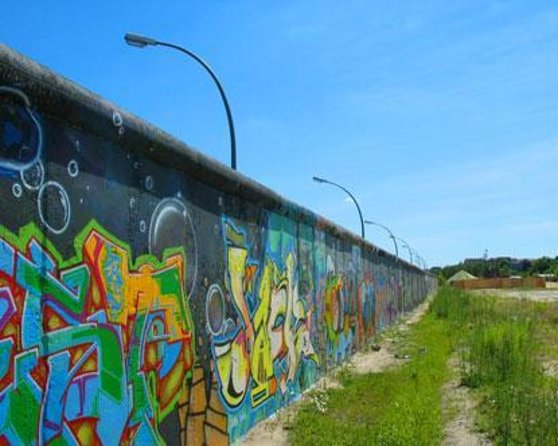
You’ll also see the Martin-Gropius-Bau, described as dedicated to cultural history, contemporary art, and photography. Then you’ll have a Wall-related stop, which helps connect the Cold War story to Berlin’s physical geography.
This pairing is smart in a short tour. It reminds you that Berlin’s identity is not only trauma and politics; it’s also art and documentation—especially fitting in a tour that is already photo-focused.
Checkpoint Charlie: the famous border crossing
At Checkpoint Charlie, you’ll hear how it became the most famous border crossing during Berlin’s division. The tour context explains it was controlled by Americans, alongside other points like Helmstedt-Marienborn (Checkpoint Alpha) and Dreilinden-Drewitz (Checkpoint Bravo). It also notes that passage was allowed for foreigners and certain German representation personnel and GDR functionaries.
Admission is listed as free here, and you’ll get quick, meaningful framing for why this place is so iconic. It’s also a great photo stop because the location is instantly legible: everyone understands what you’re looking at.
Friedrichstraße: shopping mile energy after the Wall
Between Checkpoint Charlie and Friedrichstraße station, the tour points out the shopping mile that emerged after the fall of the Wall.
This stop is practical. After history, it’s nice to land in everyday Berlin—streets where you can imagine walking rather than only looking. If you want a “this is what daily life looks like now” shot, this is where it can happen.
Gendarmenmarkt: French settlers, then a theater landmark
Next comes Gendarmenmarkt, built at the end of the 17th century based on plans by Johann Arnold Nering. The tour explains the early community included French immigrants—especially French Protestants (Huguenots). The square changed names over time, eventually becoming Gendarmenmarkt in 1799, connected to guard regiment stables and guard functions.
Admission is free at this stop, and you’ll also see the German Cathedral area and the permanent exhibition titled “Ways – Irrwege – Detours” on historical development of liberal parliamentary democracy across five floors.
Then there’s the concert hall on Gendarmenmarkt, described as a masterpiece of classical architecture and one of Karl Friedrich Schinkel’s main works. The tour also notes an earlier comedy house opened here at the instigation of Frederick the Great, built using plans by Johann Bouman the Elder, and later the rise to a leading theater.
Why this matters on a rickshaw: the square gives you symmetry and clean façades. It’s photo-friendly without requiring you to search for the “right spot.”
Bebelplatz book burning memorial: a chilling reminder
At Bebelplatz, you’ll learn about the Nazis desecrating the site with book burning in May 1933, including over 20,000 books. The tour lists authors targeted like Erich Kästner, the Mann family, Magnus Hirschfeld, Lion Feuchtwanger, Karl Marx, Else Lasker-Schüler, and others, with the tour also referencing Heinrich Heine’s remark about what happens when books are burned.
Admission is free here, and the memorial gives you a place to stop and absorb—quietly—without a formal museum schedule.
This is one of those stops where I’d recommend you slow down mentally. You’re looking at a reminder of how censorship works, and how language and power clash.
Neue Wache: a central memorial for war and tyranny victims
Then comes Neue Wache, built 1816–1818 to designs by Karl Friedrich Schinkel. Since 1993, it’s been the Federal Republic of Germany’s central memorial for victims of war and tyranny.
This is a small stop with heavy meaning. If you’re trying to understand modern Germany, memorials like this teach you how the country decided to remember.
Museum Island and Berlin Cathedral: world-class architecture zone
You’ll also reach Museum Island, noted as a standout museum complex and UNESCO World Heritage site. The tour then includes Berlin Cathedral, plus the Lustgarten on Museum Island area (connected to the former Berlin City Palace).
This section shifts into a “wow, this is built to impress” mode. Cathedral and museum settings photograph dramatically, and you’ll feel why Berlin invests in monumental public spaces.
One practical thing: because you’re riding in a rickshaw, you’ll likely be working with stop-and-shoot moments rather than long walks between buildings. Still, the exterior viewpoints can be enough if your goal is a set of strong photos and a solid sense of place.
New Synagogue on Oranienburger Strasse and Nikolaiviertel: faith and old-town texture
You’ll see the New Synagogue on Oranienburger Strasse, described as once Germany’s largest and most important synagogue. Then the route includes Nikolaiviertel, Berlin’s first and oldest residential area, with the Nikolaikirche and an old-town feel plus restaurants and coffee spots.
This is a nice pacing choice. After monumental buildings, Nikolaiviertel gives you street-scene atmosphere that looks lived-in and human-scale. It’s a good moment to take photos that don’t look purely architectural.
Alexanderplatz: big square, big Berlin energy
Finally, you reach Alexanderplatz, described as one of Berlin’s liveliest squares across the 1920s, GDR times, and today.
Even if you’re not into crowds, Alexanderplatz is a useful endpoint because it’s clearly Berlin now. It’s also a strong photo target because of its openness and wide-angle friendliness.
The photo setup: photographer, WiFi, and that warm-ride comfort
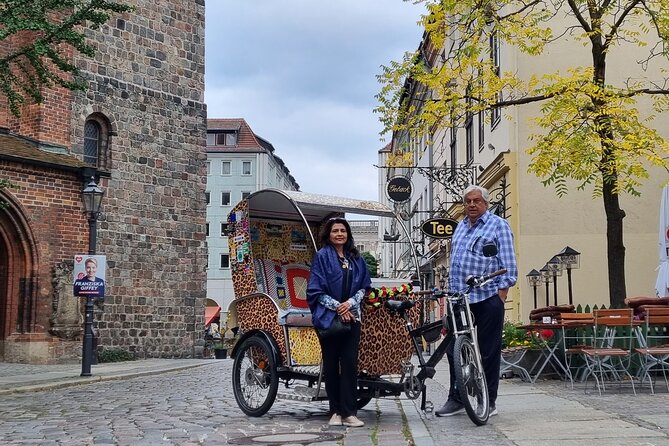
This tour is built around making photos easier. You get a photographer, and you’ll also have WiFi on board—useful for quickly checking your shots, uploading later, or sharing with friends without digging for cellular signal. You can also use music on request, which sounds like a small thing until you realize it changes the mood of the ride.
Then there’s the comfort factor: warm blanket is included. That matters in Berlin more than you’d think. Even if the sun pops out, mornings and evenings can stay cold. A warm blanket turns the rickshaw from a stubborn endurance test into a real romantic date idea.
And yes, alcoholic beverages are included. I’d treat that as a bonus for the vibe, not something you depend on. But if you like a little celebratory touch while you’re sightseeing, it fits the romance theme naturally.
Price and value for a private up-to-2 group
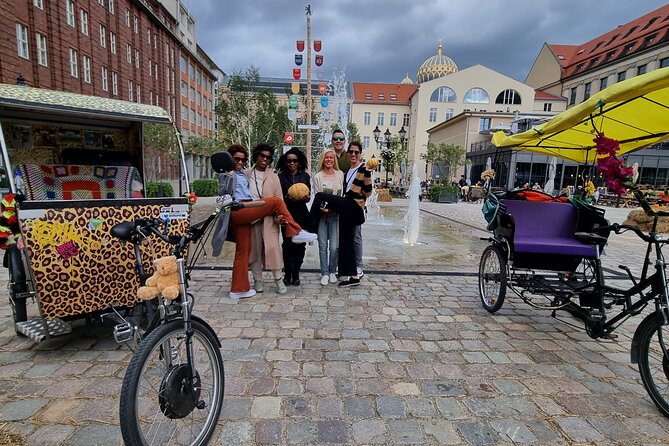
The price is listed as $183.35 per group (up to 2). That’s not cheap compared to a standard walking tour. But you’re paying for private transportation, a photographer, and built-in comfort features like blankets, plus WiFi and alcoholic beverages.
Here’s how I’d judge value for your trip:
- If you want a couple photos that look intentional, the photographer help can justify a lot of the cost.
- If you’re traveling in cold weather or just don’t want to walk, the rickshaw function is the value engine.
- If you care about the history but don’t want to research each stop, the guided context saves time.
The main cost risk is time. Because the tour is short, you’re more in the mode of getting many good photo moments than lingering at every site. If you prefer slow museum-style visits, you might want a separate day plan for that.
Cold-weather reality and what to do with it
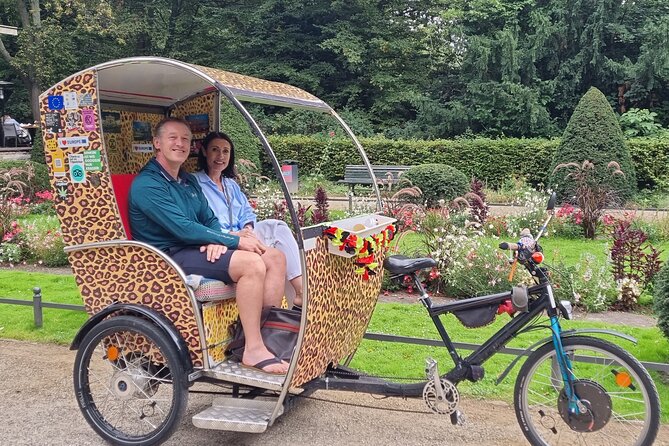
The tour requires good weather, and it’s the kind of itinerary where you’ll feel the impact if conditions are rough. The listing says if it’s canceled due to poor weather, you’ll be offered a different date or a full refund.
So what should you do? Pack for Berlin cold as if you’re going outside anyway. The warm blanket helps, but it won’t replace proper layers. If you’re the kind of person who hates numb hands, bring gloves that let you take photos.
Also, keep your expectations aligned: this is a photo-and-ride tour. In bad weather, a photo tour can become a “try to be fast and not freeze” experience. With good weather, it’s a lot more fun and relaxed.
Who this romantic Berlin rickshaw-and-photo tour suits best
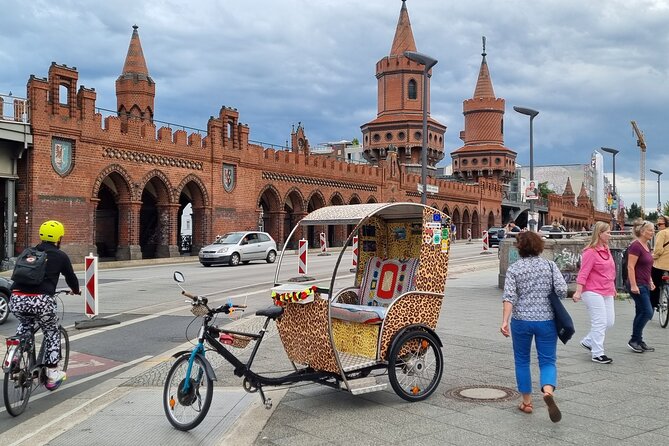
I think this tour is ideal if:
- You’re coming with a partner and want something that feels like a date, not just sightseeing.
- You want to cover major central sights without a navigation headache.
- You like history but prefer it delivered through a walking-free, stop-by-stop route.
- You care about photos and would rather have help than play photographer roulette.
It’s also a solid fit if you’re short on time and you want a structured “greatest hits plus context” plan in about 1–2 hours.
Should you book this romantic rickshaw-and-photo tour?
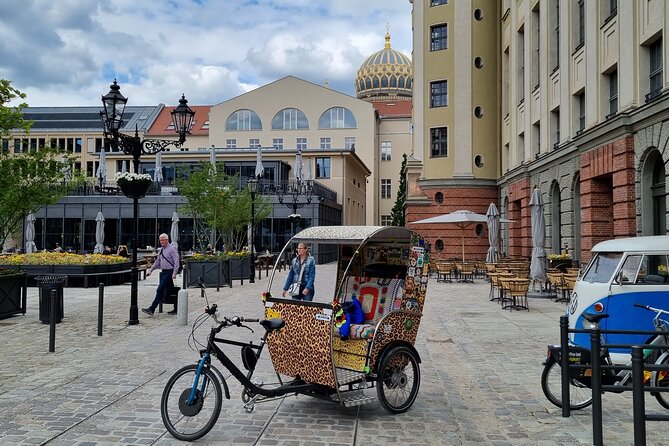
If your priorities are romance + photos + less walking, I’d book it. The private setup for up to two, the included warm blanket, and the presence of a photographer make this feel like a purposeful experience rather than a quick taxi ride with a few stops.
If, instead, you need long explanations at fewer sites, or you expect a huge amount of ride time without lots of stop-and-shoot moments, you might prefer a longer-format tour or add a dedicated time block for the sites that matter most to you.
Either way, do it when the weather is decent and plan to dress for cold. Then you’ll get the best version of this: Berlin’s big landmarks, the heavier memory stops, and a photo set you don’t have to assemble at midnight.
FAQ
FAQ
How long is the Romantic Berlin Rickshaw City and Photo Tour?
The duration is listed as approximately 1 to 2 hours.
What’s the group size for this tour?
It’s private and listed as up to 2 people per group.
Is pickup included?
Yes. Pick-up within a radius of 2 km from the Brandenburg Gate is included. Beyond that, there’s an extra €10 per km charge paid on the spot.
Is the tour offered in English?
Yes, the tour is offered in English.
What’s included in the tour price besides the rickshaw ride?
The tour includes private transportation, WiFi on board, a warm blanket, music on request, a travel guide, a photographer, and alcoholic beverages.
Are entrance tickets included for the stops?
No for everything. The Reichstag Building admission ticket is not included. Other stops listed as free include Potsdamer Platz, Topography of Terror, Checkpoint Charlie, and several central squares/memorial areas.
Is the tour dependent on weather?
Yes. It requires good weather. If it’s canceled due to poor weather, you’ll be offered a different date or a full refund.